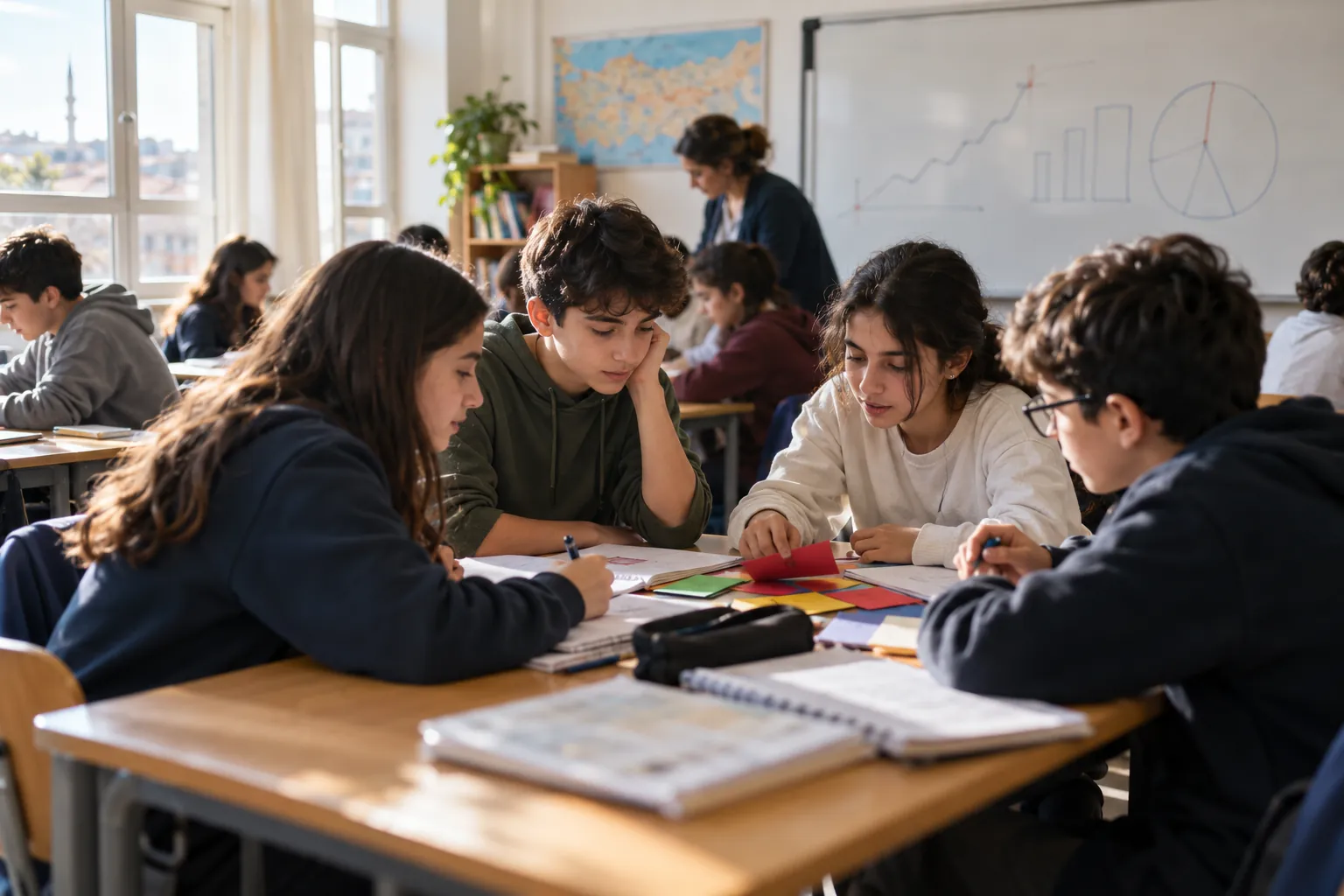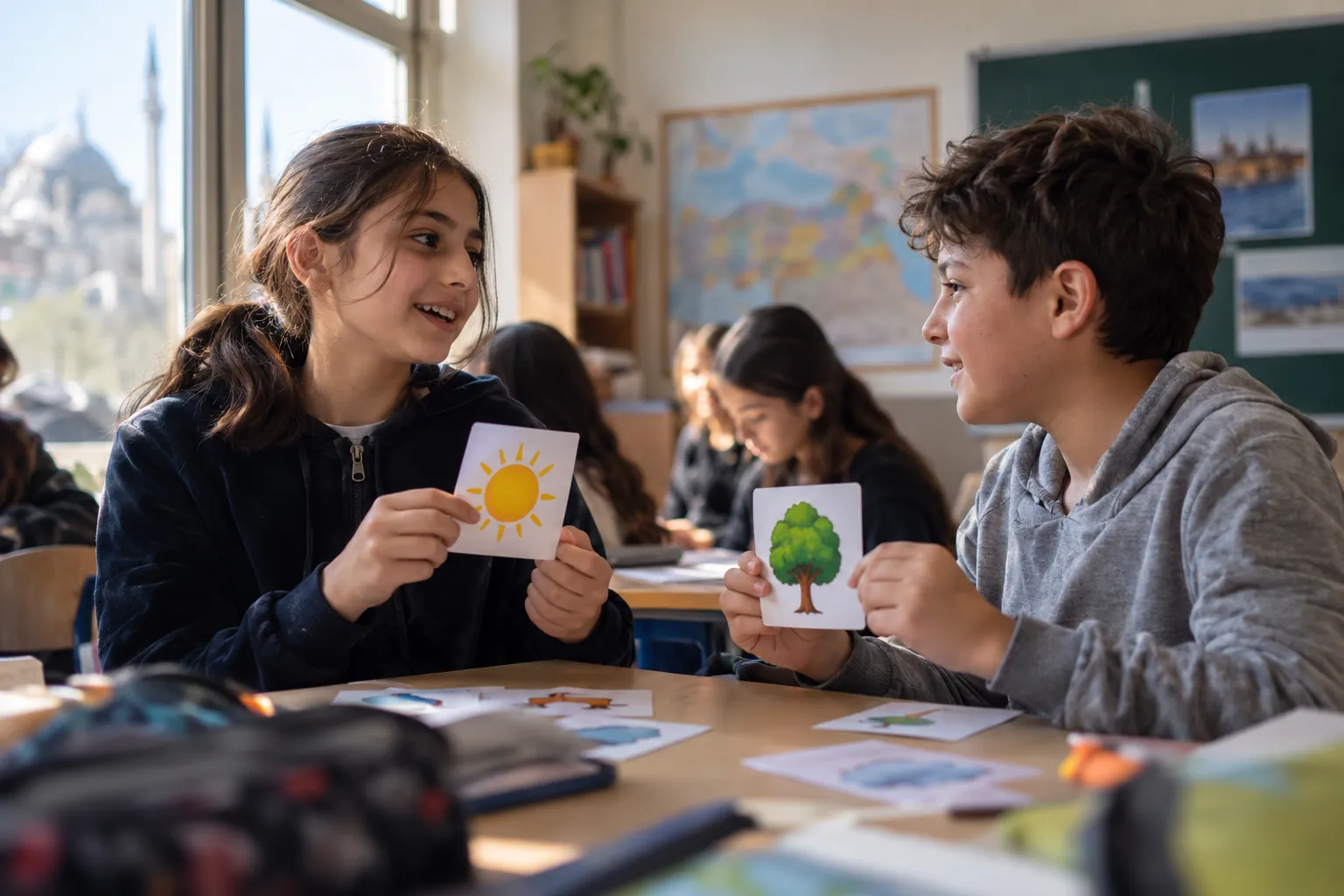
7. sınıf İngilizce temaları ve ders saatleri
Tablo, Maarif Modeli İngilizce programının “Year 7 (Level: A2.3)” süre tablosudur: 8 tema, her temada 24 öğrenme çıktısı ve 14 ders saati; toplam 192 öğrenme çıktısı ve yıllık 144 ders saati (haftada 4 saat).
| Sıra | Tema | Öğrenme çıktısı | Ders saati |
|---|---|---|---|
| 1 | School Life & Education (Okul hayatı ve eğitim) | 24 | 14 |
| 2 | Classroom Life & Learning (Sınıf hayatı ve öğrenme) | 24 | 14 |
| 3 | Personal Life & Well-Being (Kişisel yaşam ve iyi oluş) | 24 | 14 |
| 4 | Family Life & Home (Aile hayatı ve ev) | 24 | 14 |
| 5 | Life in the Neighbourhood & City and Social Life (Mahalle, şehir ve sosyal hayat) | 24 | 14 |
| 6 | Life in the World & Culture (Dünyada yaşam ve kültür) | 24 | 14 |
| 7 | Life in Nature (Doğada yaşam) | 24 | 14 |
| 8 | Life in the Universe & Future (Evrende yaşam ve gelecek) | 24 | 14 |
| Orientation (tanışma) | – | 4 | |
| Revision Programme (tekrar) | – | 16 | |
| Evaluation and Assessment (değerlendirme) | – | 6 | |
| School-Based Planning (okul temelli planlama) | – | 6 |
1. tema: School Life & Education (Okul hayatı ve eğitim)
Alt temalar: extra-curricular activities at school; competitions and celebrations at school; national days and celebrations.
| Dil bilgisi yapısı (programdan) | Ne için kullanılır? |
|---|---|
| The Simple Present Tense | Describing regular actions, general truths, and habits. |
| The Present Progressive Tense | Describing actions happening right now or around the present moment. |
| Adverbs of frequency | Expressing the frequency of an action. |
| Modals must and can’t | Expressing prohibition. |
Programdaki günlük dil kalıplarından örnekler: “What’s on the timetable today?” · “Is a non-uniform day coming up?” · “It’s my turn to be line leader today!”
Sesletim odağı: Intonation of positive statements.
2. tema: Classroom Life & Learning (Sınıf hayatı ve öğrenme)
Alt temalar: Technological tools for learning; learning activities in the classroom; cardinal numbers (500- 1000); ordinal numbers (50-100).
| Dil bilgisi yapısı (programdan) | Ne için kullanılır? |
|---|---|
| The Simple Present Tense vs Present Progressive Tense | Distinguishing regular actions, habits, general truths, permanent situations and actions happening at the moment of speaking, and temporary activities. |
| Question tags for the Simple Present Tense and Present Progressive Tense | Confirming information or actions that are happening at the moment. |
| Will for help | Offering help. |
Programdaki günlük dil kalıplarından örnekler: “No cutting corners at school, do your best at school!” · “I never throw in the towel, I always try again!” · “Slow down and double-check your work!”
Sesletim odağı: Intonation of negative statements Generalisations/Principles/Key Concepts Genera.
3. tema: Personal Life & Well-Being (Kişisel yaşam ve iyi oluş)
Alt temalar: body parts, illnesses, and keeping good health; the place of technology in people’s lives.
| Dil bilgisi yapısı (programdan) | Ne için kullanılır? |
|---|---|
| The Simple Past Tense | Describing past states of being or situations. |
| The Simple Past Tense | Describing completed actions or events that occurred in the past with regular verbs. |
| The question tags for “to be- was-were” and the Simple Past Tense | Confirming a past action or a past state of being. |
Programdaki günlük dil kalıplarından örnekler: “Staying active is key to feeling great!” · “Scroll less, live more!” · “Unplug and unwind!”
Sesletim odağı: Intonation of questions and question tags.
4. tema: Family Life & Home (Aile hayatı ve ev)
Alt temalar: Family members’ hobbies ( sports ,books, films, music, cooking); generation gap in the family; problems and solutions.
| Dil bilgisi yapısı (programdan) | Ne için kullanılır? |
|---|---|
| The Simple Past Tense | Describing an action that happened in the past. |
| Question tags for the Simple Past Tense | Confirming information in the past. |
| Shall for suggestions | Suggesting actions in the near future. |
Programdaki günlük dil kalıplarından örnekler: “My mum’s mad about cooking new recipes!” · “My parents think I’m glued to my phone!” · “We try to meet halfway on family activities!”
Sesletim odağı: a, b, c, d, e Vowels: a: (/ae/, /aeı/, /ə/, /a:/, /eɪ/, /a:/, /a/, /ɔː/, /eə/); .
5. tema: Life in the Neighbourhood & City and Social Life (Mahalle, şehir ve sosyal hayat)
Alt temalar: Public services in the neighbourhood and city; life in different kinds of cities.
| Dil bilgisi yapısı (programdan) | Ne için kullanılır? |
|---|---|
| The Past Progressive Tense | Expressing actions that were ongoing at a specific time in the past or were interrupted by another action. |
| Question tags for the Past Progressive Tense | Confirming information or asking for agreement about actions that were ongoing at a specific time in the past or were interrupted by another action. |
Programdaki günlük dil kalıplarından örnekler: “Our community is close-knit, everybody knows each other!” · “Our neighbourhood is family-friendly with parks and schools!” · “There are many well-maintained gardens in this area!”
Sesletim odağı: f, g, h, i, j, k Vowel: i: (/aı/, /ı/, /i:/) Consonants: f: (/f/); g:(/g/, /dʒ/).
6. tema: Life in the World & Culture (Dünyada yaşam ve kültür)
Alt temalar: Capitals, landmarks, famous places, and activities in capitals; sports events in different parts of the world.
| Dil bilgisi yapısı (programdan) | Ne için kullanılır? |
|---|---|
| The Present Perfect Tense with “for” | Expressing actions or states that began in the past and have continued up to the present for a specific duration. |
| Question tags for The Present Perfect Tense | Confirming information, encouraging agreement, or seeking reassurance about actions or experiences that started in the past and continue into the present. |
Programdaki günlük dil kalıplarından örnekler: “Some souvenir shops are tourist traps in this city!” · “The stadium is packed, everyone here is football mad!” · “We’re taking in the sights of İstanbul this weekend!”
Sesletim odağı: l, m, n, (ng), o, p Vowel: o: ( /əʊ/, /ɒ/, /əʊ/) Consonants: l: ( /ɛl/ /l/); m (.
7. tema: Life in Nature (Doğada yaşam)
Alt temalar: Animals and natural resources in nature; protecting animals and nature.
| Dil bilgisi yapısı (programdan) | Ne için kullanılır? |
|---|---|
| Zero Conditional | Express general truths, scientific facts, or habits that occur when a condition is met. |
| Comparatives of regular and irregular adjectives | Comparing two things, highlighting differences. |
| Superlatives of regular and irregular adjectives | Expressing the highest or lowest degree of a quality among three or more things. |
Programdaki günlük dil kalıplarından örnekler: “Take a leaf out of your brother’s book-he always protects the nature!” · “Cut down on waste and use reusable bottles!” · “Make a change by planting more trees!”
Sesletim odağı: q, r, s, t, u Vowel: u: (/juː/, /ʌ/, /juː/) Consonants: q: /kjuː/, r: /ɑː/(Br), .
8. tema: Life in the Universe & Future (Evrende yaşam ve gelecek)
Alt temalar: Space technology; life in the future with robots.
| Dil bilgisi yapısı (programdan) | Ne için kullanılır? |
|---|---|
| “Be Going to Future Tense” | Expressing future plans, intentions, or something that is likely to happen based on present evidence. |
| The Simple Future Tense | Expressing predictions about what might happen in the future or decisions made at the moment of speech. |
| Question tags for the future with “be going to” and “will” | Confirming information, encouraging agreement, or seeking reassurance about future actions, plans, intentions and predictions. |
Programdaki günlük dil kalıplarından örnekler: “We can change the world with technology!” · “The Earth is our blue planet!” · “Recycling is a step in the right direction!”
Sesletim odağı: v, w, x, y, z Consonants: v: (/vi:/); w: (/dʌbəlju:/, /w/); x: (/ɛks/, /ks/, /gz.
Tema takip çizelgesi
Okulda işlenen temaları ve dil yapılarını işaretle; kalan tekrarın ne zaman biteceğini gör.
Cihazında saklanır · kayıt yok
Konu takip ve yetişme hesabı
Bitirdiğin konuları işaretle, haftada kaç konu bitirebildiğini seç; kalan konuların ne zaman biteceğini ve sınava yetişmek için gereken temponu gör.
Temalar ve dil yapıları Maarif Modeli İngilizce programı Year 7 bölümünden. İşaretlerin yalnız bu cihazda tutulur.
7. sınıf İngilizceye nasıl çalışılır?
- Kelimeyi bağlamla öğren: Program her temada kelimeleri “kullanımda” verir; her yeni kelimeyle kendi cümleni kur.
- Yapıyı kuralından önce örnekte gör: Year 7 programı tümevarımsal yaklaşımla kurgulanmıştır (öğrenci örneklerden kuralı çıkarır).
- Dinle-konuş: Haftada birkaç kez kısa İngilizce videoyu dinleyip iki cümleyle anlat.
- Yazılı hazırlığı: Okul yazılılarının tarihini ve kapsamını okul belirler; 1. dönem kapsamı için 7. sınıf 1. yazılı konuları.
- LGS bağlantısı: LGS’de yabancı dil sözel bölümde 10 soruyla sorulur; 8. sınıf ünite kelimeleri için LGS İngilizce konuları.
Kaynaklar
- İngilizce (2-8. sınıflar) Dersi Öğretim Programı (Türkiye Yüzyılı Maarif Modeli, 2026): 7. sınıf — T.C. Millî Eğitim Bakanlığı, Talim ve Terbiye Kurulu Başkanlığı
- Türkiye Yüzyılı Maarif Modeli öğretim programları (2026 güncel metinler) — T.C. Millî Eğitim Bakanlığı, Talim ve Terbiye Kurulu Başkanlığı
Bu rehberi kim hazırladı?
Aile ve Eğitim Koçluk Ekibi — İstanbul merkezli, Türkiye geneli online öğrenci koçluğu, mizaç analizi ve veli atölyeleri. Rehberlerimiz koçluk görüşmelerinde en sık karşılaştığımız soruları ve güvenilir kaynakları temel alır; resmî kurallar değiştiğinde güncellenir.
Yaklaşımımızı tanı